
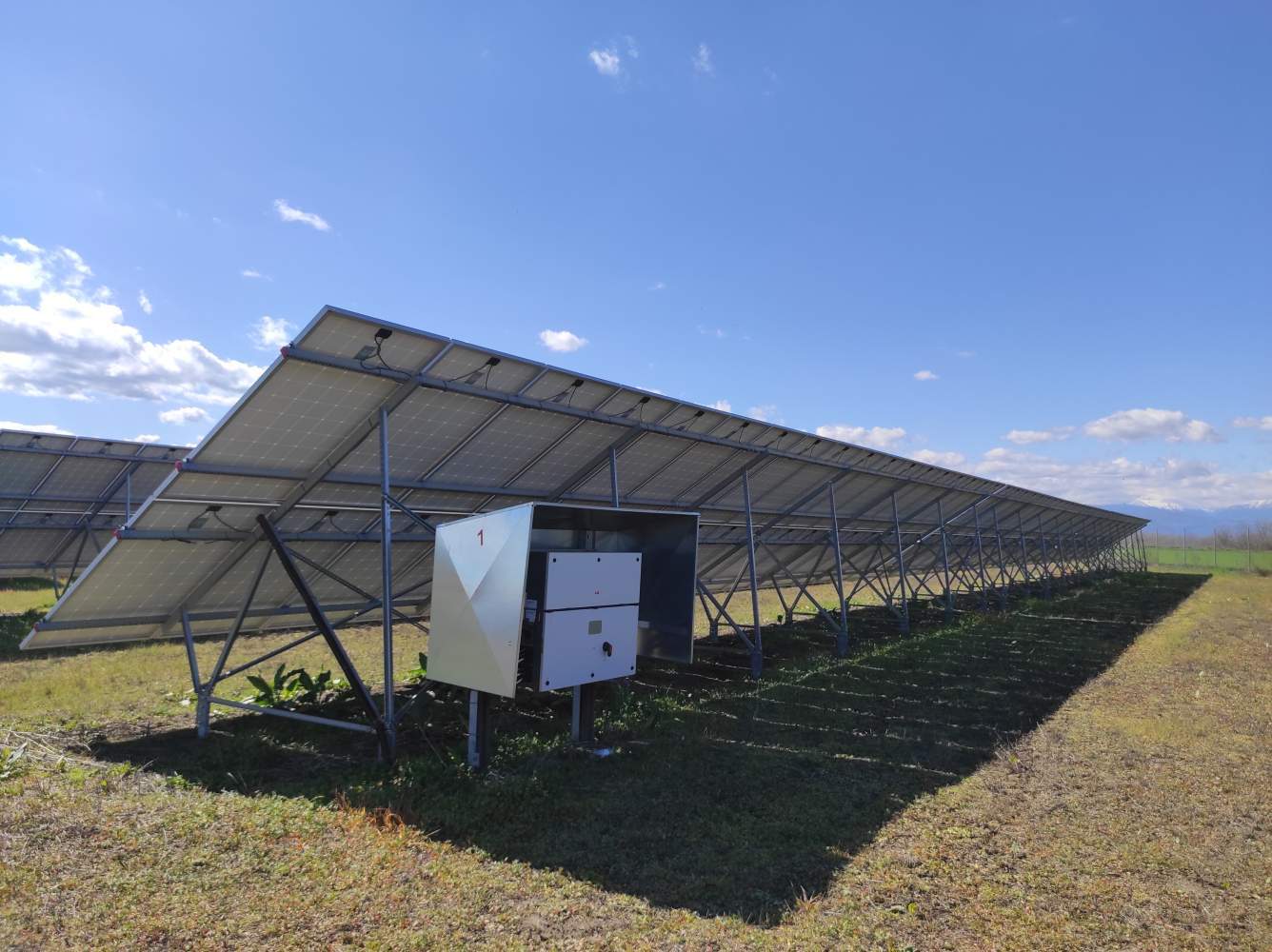
Changeable Inclination
Adjustable Mounting Systems
The Smart Solution for Higher Energy Yield


tilt of Summer intermediate tilt tilt of Winter
Technical Principle and Physical Basis of the Benefit
The Earth’s rotational axis is not perpendicular to the plane of its orbit around the Sun, but is tilted by approximately 23°26’. In addition, this axis maintains a constant orientation in space. As a result, throughout the year, the position of the Sun in the sky changes significantly.
For approximately half of the year (March 21 – September 22), the Northern Hemisphere “leans” towards the Sun, reaching a maximum around June 21, while during the other half of the year the opposite occurs, with a maximum around December 21. These moments are known as the solstices.
In the temperate zone, during summer the Sun is:
-
higher in the sky, and
-
visible for more hours above the horizon,
while in winter it is:
-
lower, and
-
visible for fewer hours.
This means that the optimal tilt angle of photovoltaic modules is not the same throughout the year.
Adjustable tilt mounting systems take advantage of this physical reality, allowing solar rays to strike the surface of the panels as close to perpendicular as possible, thereby increasing energy yield.
Investment Advantage – Higher Production, Better IRR
Compared to fixed-tilt structures, adjustable tilt systems offer:
-
5% to 10% increase in annual energy yield, depending on location and module type
-
Improved production profile during critical periods of the year
-
Significant improvement of key financial indicators (IRR, LCOE)
-
Faster payback of the additional cost compared to fixed-tilt systems (typically within 2–3 years)
-
A simple, low-risk alternative to trackers, without complex moving parts and without increased maintenance requirements
In simple terms: this is a solution that increases project revenues without proportionally increasing technical and operational risk.
Tilt Range and Real Design Constraints
The optimal tilt range depends on:
-
Geographical latitude (southern regions → lower tilt angles, northern regions → higher tilt angles),
-
Length of the photovoltaic modules, and
-
Shading constraints, mainly during winter, to avoid shading of the rear rows.
PROFILODOMI takes all these parameters into account in the engineering design of each project.
PROFILODOMI Adjustable Mounting Systems – A Proven Solution
PROFILODOMI has thoroughly studied this technical approach and, based on documented data from real projects, has demonstrated that seasonal tilt adjustment leads to measurable increases in energy production.
The company has developed a complete range of adjustable mounting systems, adapted to:
-
the required tilt range per location,
-
module dimensions,
-
installations on ground, concrete rooftops or industrial roofs,
-
single-row or double-row configurations.
More than 300 MWp have already been installed using PROFILODOMI adjustable mounting systems, in parks and project clusters ranging from Africa to Sweden.
Tilt Adjustment in Practice – Fast, Simple, and Fully Applicable
Adjustment is performed per table, by 2–3 people, in just 3–4 minutes.
Only the following are required:
-
2 portable battery-powered impact drivers,
-
and relocating the bolts to the predefined tilt positions.
The procedure:
-
Two people (one at the front and one at the rear) remove the bolts.
-
The table is now free, balanced, and safe.
-
Three people raise or lower the table to the desired tilt angle.
-
Two people reinstall the bolts in the new positions.
-
The team moves on to the next table.
👉 A 1 MWp solar park can have its tilt adjusted in less than 8 hours by a crew of only 2–3 people.
This means that seasonal adjustment is not just theoretical, but is applied in practice — and the additional yield is converted into real, measurable financial benefit.
Additional Operational Benefits
-
Better ventilation and cooling of the panels, especially in the more horizontal summer position
-
Reduced risk of vegetation shading on the front rows
-
Cleaner and more stable operation of the plant over time
Configurations and Technical Options
Table Configuration
-
Two rows of modules in portrait orientation
Optimized layout for large-scale plants with high installation density and controlled shading.
Pile Foundation Configuration
-
Two-pile configuration with U or C profile piles
Suitable for typical soil conditions and offering high structural robustness. -
Single-pile configuration with IPE120 pile
A solution for special soil conditions or geometric constraints.
Module Compatibility
-
Modules with length up to approximately 2.40 m
-
Bifacial modules
-
Thin-film modules
Adaptation to Site Conditions
-
Adjustment of pile embedment depths depending on soil conditions
-
Possibility to use concrete-embedded piles
-
Custom-engineered solutions for projects with specific geotechnical or layout requirements
Conclusion
Higher production, improved financial performance, without the complexity of trackers.
A solution with a proven track record of hundreds of MWp in real operation.
Αντίστοιχες Βάσεις | Relative systems

For 2 Rows of Solar modules Vertical . Range of tilt 10°-35°
Components of the Mounting… Περισσότερα
Mounting System PD.1C.1P2124/ 10-35 with CHANGEABLE INCLINATION
for 1 row of… Περισσότερα
.
